
Raccoons in the ductwork. Iguanas inside pool equipment housing. An opossum nesting in a sealed crawl space I had to cut open to reach. After 24 years of wildlife removal work across South Florida, I have handled animal removal situations that most pest companies are not licensed, trained, or equipped to address. Wildlife pressure here is year-round. The animals find entry points you don’t know exist, and they use them.
Florida has two distinct licensing requirements for wildlife work. Most homeowners know neither exists. An FDACS Limited Commercial Wildlife Management (LCWM) certification is required to trap and remove mammals from structures in Florida. A standard pest control license does not cover this. If the company you hire lacks that certification and removes a protected species without proper authorization, the legal exposure shifts to you as the property owner. I hold the correct FDACS certification.
The Florida Fish and Wildlife Conservation Commission (FWC) separately governs which species can be trapped, how, and when. All bat species are protected under both state and federal law. Migratory birds fall under the Migratory Bird Treaty Act. A wildlife company without current FWC permit authorization for protected species cannot legally service your property, and hiring one puts you at risk in the process.
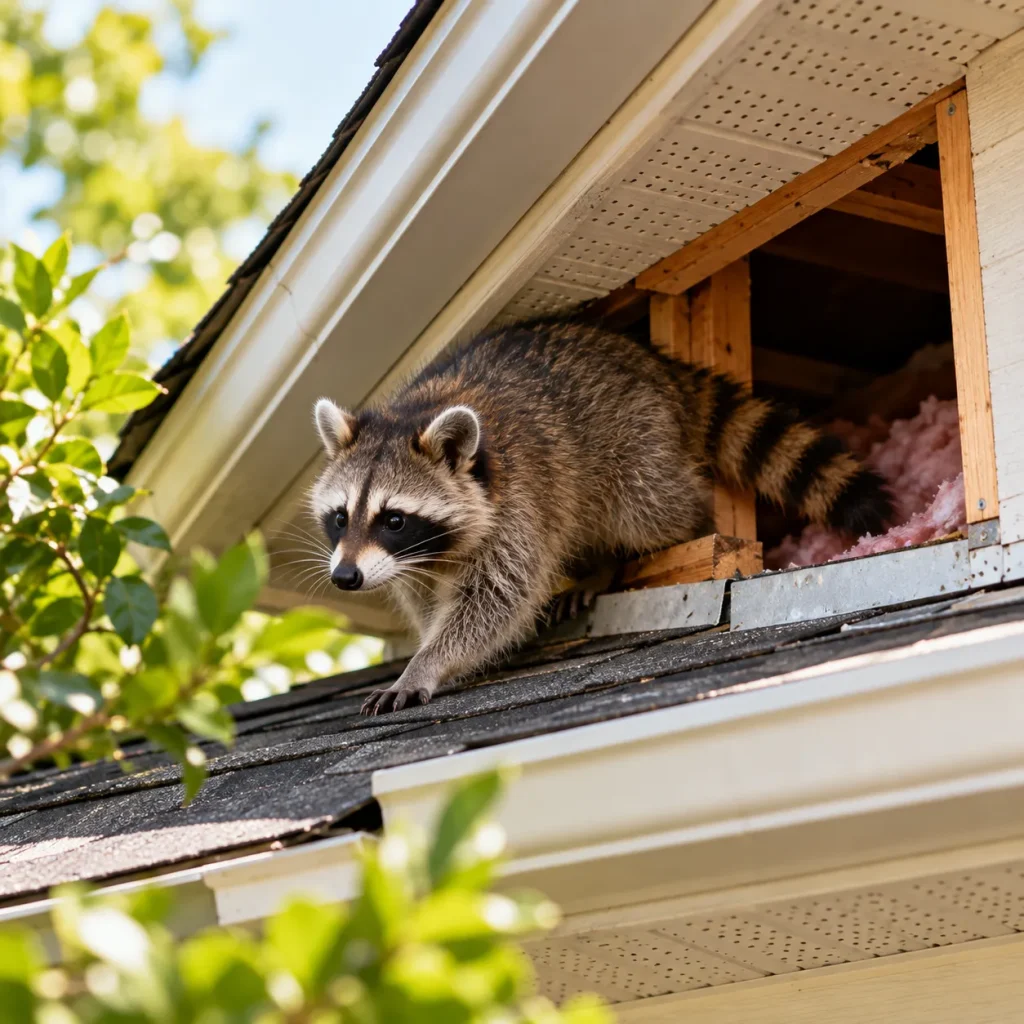
Removing the animal is step one. Sealing the entry point is step two. Without both, the same species returns. Raccoons leave urine scent trails in attic insulation that signal other raccoons back to the same soffit gap or ridge vent. I map every documented access point before the first trap is placed, and I seal them after removal is confirmed.
An animal that spends weeks in an enclosed attic space leaves behind droppings, urine, and nesting material. Raccoon feces can harbor Baylisascaris procyonis, a roundworm whose eggs remain viable in contaminated insulation for years. Removal without decontamination leaves that health risk in place. I address both as part of the same job.
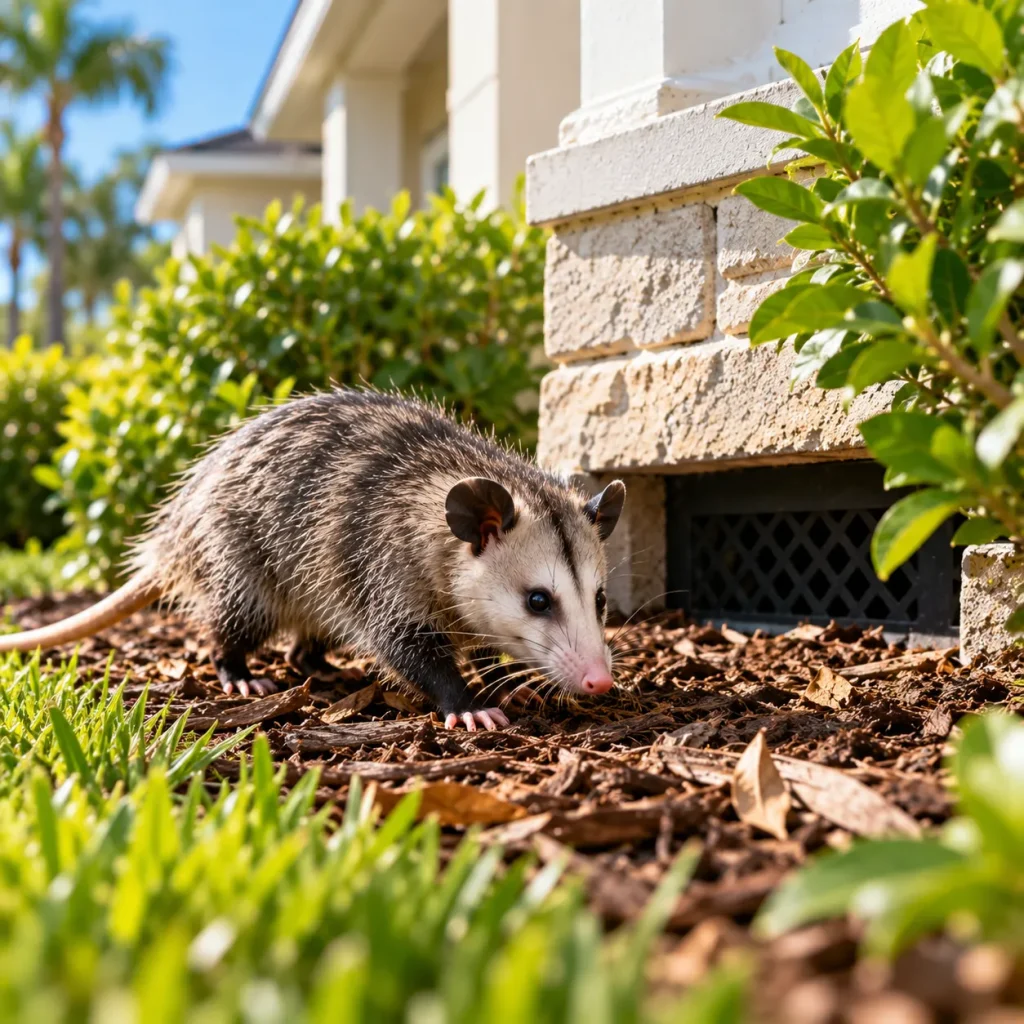
The wildlife that shows up most often in South Florida structures includes the Virginia opossum (Didelphis virginiana), the common raccoon (Procyon lotor), the invasive green iguana (Iguana iguana), the nine-banded armadillo (Dasypus novemcinctus), gray squirrels, and several snake species. Each one enters a structure for a different reason.
Raccoons seek dry, elevated harborage to raise young, and they’ll dismantle attic insulation to get comfortable. Opossums are opportunistic and move into whatever accessible space exists.
Iguanas avoid cold surfaces, which makes seawall gaps and warm foundation cavities attractive when ambient temperatures drop below 50 degrees Fahrenheit.
Knowing why the animal is present determines how to remove it and, more importantly, how to stop the next one. A live-cage trap works for a raccoon with an established den.
It doesn’t solve the underlying access problem. I identify the species first, locate the entry mechanism, then apply the correct method. That sequence matters.
Raccoons return because the entry point was never sealed first. A raccoon raising young in an attic leaves urine scent trails that signal other raccoons back to the same location. Trapping removes the animal but not the scent. Sealing the soffit return or ridge-cap gap is what stops the cycle.
The green iguana (Iguana iguana), an invasive species, excavates burrows up to six feet deep near seawalls, pool decks, and concrete foundations. That digging destabilizes soil beneath structures. Seawall sections crack from sustained burrow activity. Removal involves live trapping and a site assessment before structural repair becomes the next step.
Virginia opossums (Didelphis virginiana) are difficult to extract from crawl spaces. They play dead when threatened, complicating trap assessment. A female may carry up to 13 joeys, and that changes the removal approach. I always check for young before relocating any female opossum. Missing that step means a second removal call.
Nine-banded armadillos (Dasypus novemcinctus) dig burrows up to 25 feet long beneath slab foundations and pool decks. The digging creates voids. Voids cause settling. By the time cracking appears in the concrete, the armadillo has been active for weeks undetected. Trapping and filling the burrows together address the problem completely.
Over 16,500 jobs across South Florida, I have seen one pattern repeat itself. The problem that started as a $400 animal removal call became a $6,000 structural repair because the homeowner waited six weeks. Raccoon droppings in attic insulation create contamination that compounds with time. Armadillo burrows beneath pool decks create voids that cause settling. Iguana burrows along seawalls undermine the structure from below, section by section, until the repair bill is unavoidable. The removal cost is rarely the expensive part. What comes after it, when the problem has been ignored for weeks, is.
I start by verifying exactly what animal I am dealing with and where it is located. Entry points, tracks, droppings, odors, and scratch patterns each point to a specific species. Identifying the wrong animal means setting the wrong trap.
Before any trap is placed, I document every gap and access point on the structure. An unmapped entry point becomes a re-entry point later. This step protects the sealing work that follows and prevents a second call for the same problem.
Trap type, bait selection, and placement are species-specific. A cage trap set for an opossum won't work on an iguana. A ground-level trap won't capture a raccoon denning in the attic. I match the method to the confirmed species and its precise location.
Relocation follows Florida Fish and Wildlife Conservation Commission guidelines. Protected species, including all bat species, require specific FWC permits before any exclusion or removal work begins. The legal exposure for noncompliant removal falls on the property owner.
A: Animal removal is the extraction of nuisance wildlife from a structure or property, including sealing entry points and addressing any contamination left behind. The species determines the required method and legal requirements.
A: Florida wildlife removal ranges from $150 to $700 per animal, depending on species, severity, and access difficulty. Attic decontamination and entry-point sealing are priced separately after the initial inspection.
A: Florida law allows live-trapping certain nuisance species on private property. Protected species, including all bats, require separate FWC permits. Using incorrect trap types on mammals can result in regulatory citations.
A: Wildlife in an attic contaminates insulation with droppings, chews wiring, and damages ductwork. Raccoon roundworm eggs remain viable in insulation for years. Every week of inaction increases remediation costs significantly.
A: Wildlife removal in Florida requires an FDACS Limited Commercial Wildlife Management certification, not just a standard pest control license. Protected species require separate FWC permits before any trapping or exclusion work begins.
An inspection takes less time than you’d expect. I’ll identify the species, locate how it got in, and tell you exactly what sealing the entry involves. Call ProTerra Pest Control. One conversation gives you the full picture.